Thursday, August 22, 2013

Canada, Eh?! (pronounced: “A”, as in Hey without the H)

. . . We’ll Miss You, But Are Glad to be Back in the U.S.


Last Images of Canada

Canada is a gorgeous country. Before leaving Canada behind, we have a few more images to share:


This type of fishing boat may be unique to the North Channel and Lake Huron. That's where we began seeing them. The high sides with no walkway are unusual. A sea gull hitched a ride atop the antenna, and another rode on the dinghy on the cabin top.


Canadians love flowers and their gardens. In Killarney, between Georgian Bay and the North Channel, Black-eyed Susans were side by side with Gaillardia at the Mountain Lodge Marina.


From the time we entered Canadian waters, we saw float planes either flying about or parked in someone's back yard near the water. This float plane landed as the sun was lowering in Killarney, Ontario.


Kent's breakfast one morning was cereal with wild blueberries that Mike and Cindy had picked. And they didn't even have to fight off bears to get them.


A stalk of bountiful pink lilies were growing near Thessalon City Marina, in Ontario.


This, my friends, is what Walmart looks like in Canada -- a Supercentre. The brands were mostly Canadian. That's as it should be. The departments are like any Walmart in the U.S. The merchandise is different. This Walmart is the only one we found near the waterways in Canada.


Canadian marinas dressed up their docks and greenways with flowers. Huge pots of mixed flowers lined the docks at Thessalon.


Conchy Tonkin’


At Blind River Marine Park, Ontario, Kent blew the conch horn for the last time in Canada to signal the setting of the sun. A minute later, a South Carolina Looper blew his conch horn in response. Then minutes later, a sailor on a San Francisco 
trimarand blew his conch horn!  Since Marathon, Kent has usually been the sole conch horn blower at sunset. It was really cool to have a conch concert!


Aloha to Spiritus


At Blind River, we said Aloha (goodbye) to our trawler friends, Eddy and Linda on Spiritus. They crossed to the U. S. the next day. It takes longer for us slow sailboats. We fully expected to say Aloha (hello) to them again somewhere along the way, never dreaming it would be the next day, our first night back in the U.S.


Linda, the pirate queen, threatened to board us before she left for new conquests. Little did she know that we had a grappling hook aboard and thought about hooking on to Spiritus for a tow to our next destination.


“Home” at Last
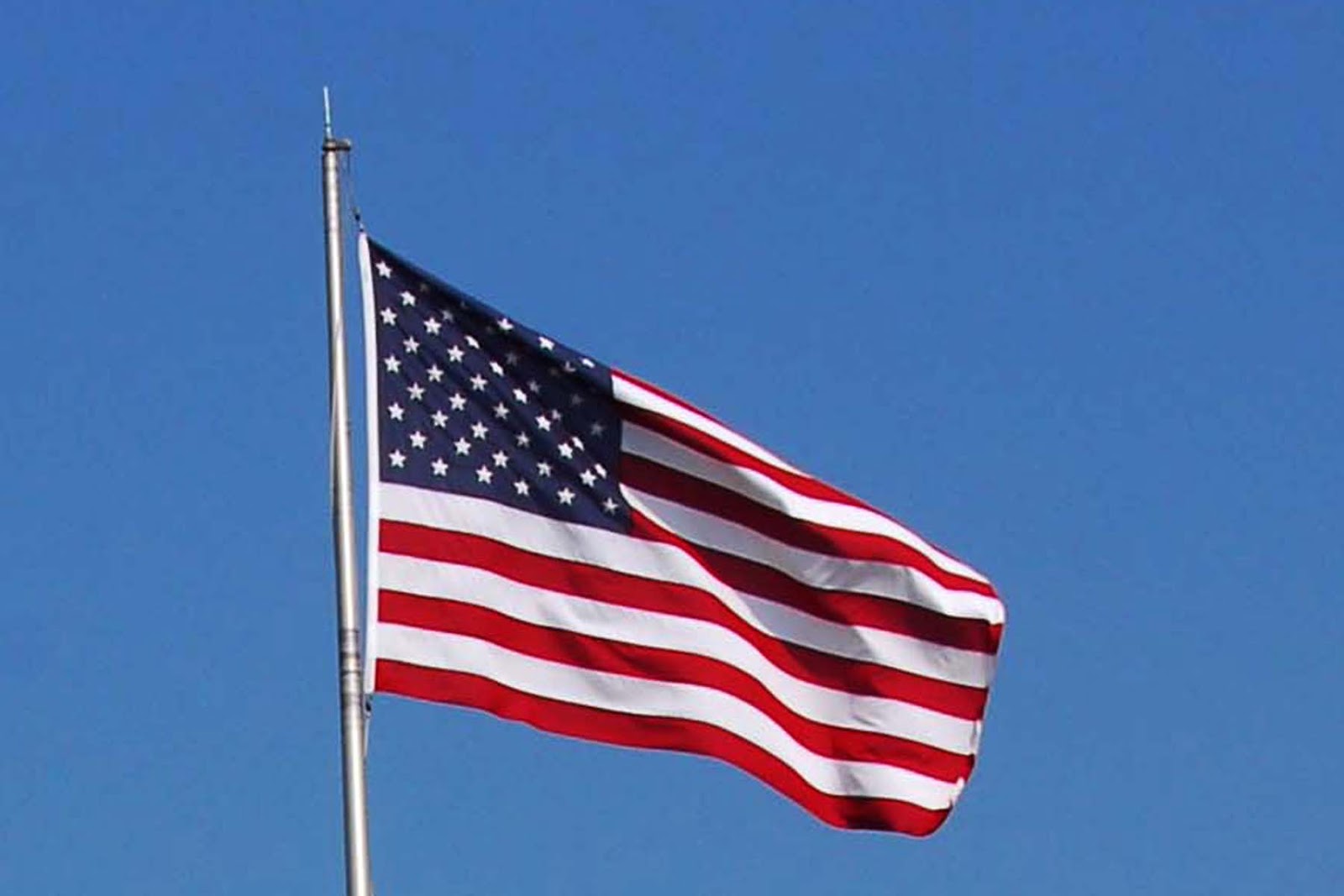


Yesterday we cleared U.S. Customs, leaving Canada early, to avoid high wind and waves on Lake Huron.  Every country has problems, the States being no exception. It's still a great place to live. Seeing the stars and stripes of our flag gave us chills and put big grins on our faces.

To give Canadians credit, they are better flag wavers than the U.S., at least along the waterways. Every home or cottage had a flagpole and maple leaf flag, no sports or college flags.


U.S. Customs shared space at the Drummond Island Yacht Haven. Note the sign on the side offering various services. U.S. Customs is just below Bicycle Rentals and just above Pump Outs.


Immigration Officers Check us Out

While sailing toward Mackinac (pronounced: Mackinaw) Island today, an impressive silver boat with huge motors curved around and slowly motored next to us. It was U.S. Immigration and Border Patrol just checking to be sure we’d cleared Customs and that we were on the up and up. To block the wind that morning, we'd zipped the side panels in, enclosing the cockpit. That may have roused their curiosity about us.

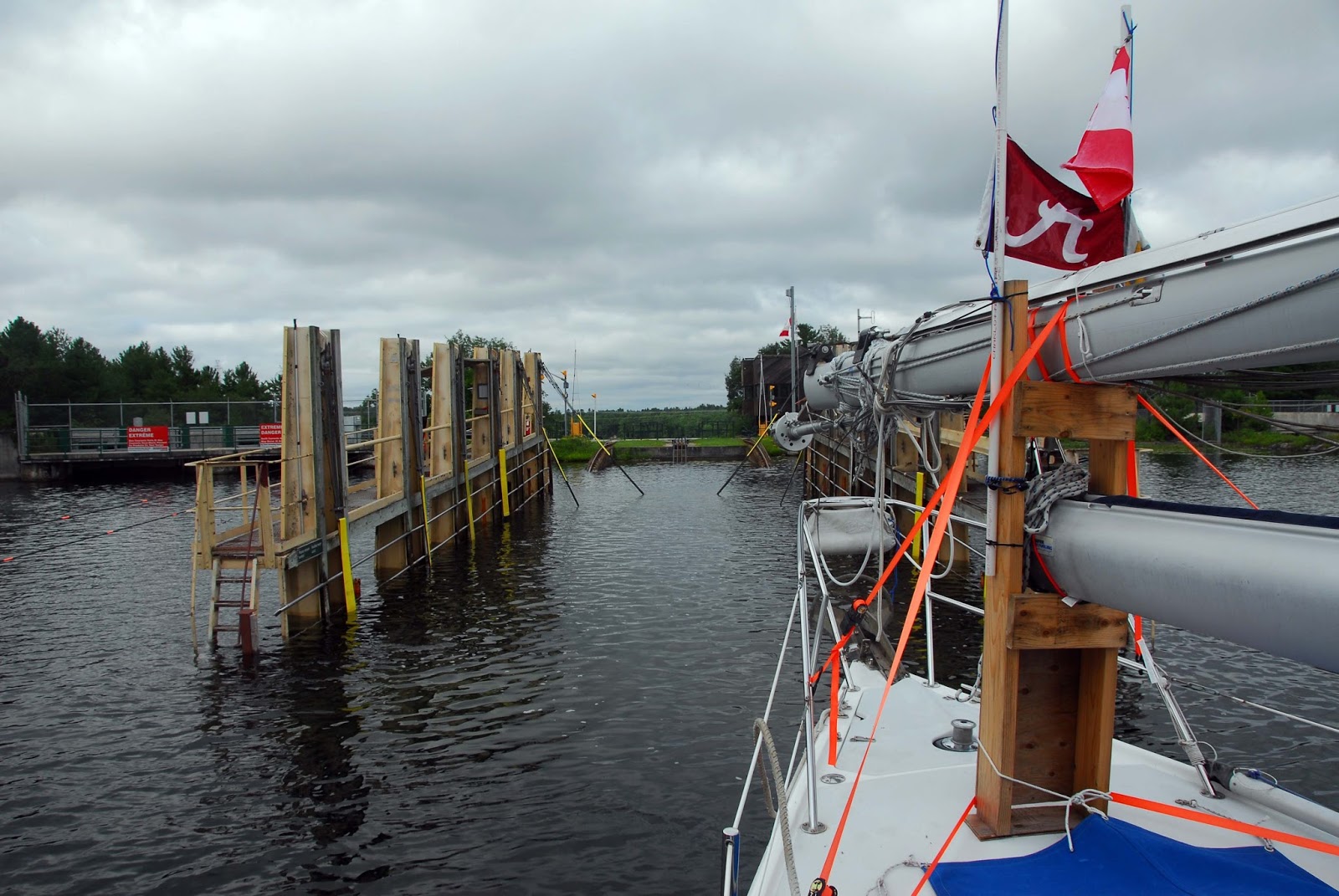
The lead officer had a southern accent mixed with some Michigan. He asked where we’d come from that morning. Our minds emptied, and we had to get our log to look it up. He asked where we’d cleared Customs. We went “duh.” It wasn’t our finest moment, but they let us stay despite our initial forgetfulness.  Then he asked why we didn’t have a Vols flag instead of the Bama flag since we were from Tennessee, but a big Roll Tide and a grin were his answer. Thankfully, he grinned back.

Caribbean Blue Waters in Michigan


Traveling the Loop changes preconceived ideas we had about geography, history and so on. Yet another surprise was in store when the deep, clear blue water of Canada’s side of Lake Huron changed to Caribbean blue as we sailed into the U.S. side. Who would have thought the water in Michigan would be the same beautiful turquoise as off Destin, Florida?!


Canada’s Gift to the Americas

As we said goodbye to Canada, its gift to the Americas said goodbye to us. . . in a way.


Saturday, August 17, 2013

Love Canada, But


. . . Ready to Be Back in the U.S.A.


Please don’t misunderstand. Canada is a wonderful country. Its people are spectacular. It’s just not home. Neither is Michigan, but it’s in our home country.  Internet, phones and bank cards work there.

We can get our mail there and pay bills. Who would think we’d be this happy to pay bills?!


Ice Road Truckers is No Joke


After a stop in Midland to have our masts raised, Aurora (in photo) and Carina hit the road again, in a manner of speaking. The mural showing the history of Midland on the grain elevators is the largest historical outdoor mural in North America.

Canadian waters do freeze in the winter -- even big Georgian Bay freezes.  A biker who gave us directions when we were in Midland said it snowed four feet every winter, the bay freezes several feet thick and people love it. He couldn’t imagine living elsewhere. We’ve got to admit that it’s really beautiful and a sailing paradise for the few months that it’s thawed.


In fact, we’re afraid we may see the bay freeze this week. The Georgian Bay winds and unseasonably cool temperatures make this area, well, cold. . . cold enough to get Mr. Heater out.


Carina’s sails were out one beautiful balmy 60-degree day on Georgian Bay.


Most Canadians live within 100 miles of the U.S. border, leaving a lot of Canada farther north. The Ice Road Truckers serve those far north people.

30,000 Islands, 1 Million Rocks

 A typical rock island is in front of a Georgian Bay range light.

For the past few days, we’ve traveled through the 30,000 Islands section of Georgian Bay.  For every rock island above the water, there are about 10 or more beneath. Some charts show that many underwater rocks are named. We've seen Jane Rock, for instance. There’s no Kent Rock so far.


The islands are part of the Precambrian Shield, some of the oldest rocks on earth.  All are carved or marked some way by the glaciers that covered this area during the Ice Age.


Since entering Georgian Bay, we’ve noticed stacked-stone men on many points. Called inuksuk, these particular sculptures are a recent addition to the landscape, not a prehistoric remnant. They are interesting, nonetheless. Their history is with native Inuits in Canada who used them are markers in their travels. Inuksuks are increasingly becoming a national symbol of Canada. 


As remote as these rock islands are, many have one or more cottages built on them. Sometimes they are more than cottages and are actually full-sized homes that people live in three months of the year. Maybe.


The islands are often stark and windswept. Although many cottages have electricity, most islands can be reached only by boat.


The Pointe au Baril Station is a picturesque, historical lighthouse midway up Georgian Bay. It’s located near Hangdog Reef and Shoals. We’re used to reefs being coral and shoals being silted areas. At Hangdog, the reef is rock above the surface, and the shoals are rocks below the surface.


A Loopy Coincidence


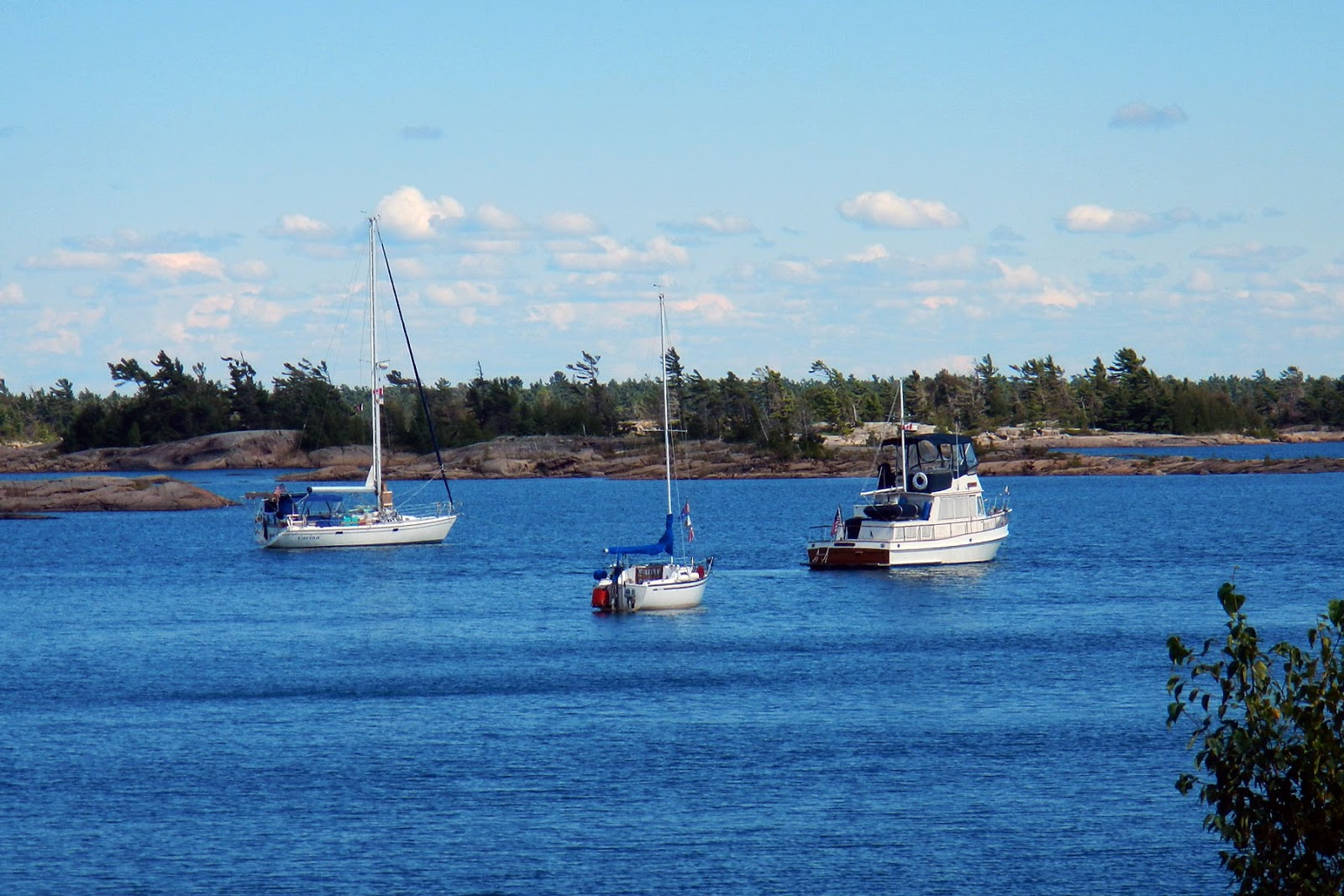
We continue to travel with Cindy and Mike on Aurora (center), now joined by close friends that they met early on the Loop, Eddy and Linda on Spiritus (right), a Grand Banks trawler. 


In one of those odd Great Loop coincidences, Aurora, Spiritus and Carina all started to cross the Gulf on the same day in November. We didn’t meet them until we ran into each other in Canada. Aurora and Carina both left from C-Quarters Marina to do the crossing, although we’d not met when there. After hours in the Gulf, the seas that day were a little too much for Aurora, a 22-foot Hunter, so Mike and Cindy ducked into Steinhatchee, Florida, and later hopscotched down the Florida coast.


Carina and Spiritus made the crossing, both going to Tarpon Springs, and docked two spaces away from each other. A giant trawler was between us at the dock. Although we waved and said, “hi,” we never really met.


Eddy (center) clowns around with Kent (left) and Mike (right) while exploring Horsley Island.


Raindrops glitter on the water in the Golden Sword Island anchorage while Eddy and Mike rush to close Spiritus up.


Now our paths have crossed again. Oddly enough, all three boats will end our Loops very near each other. In fact, Carina and Spiritus will cross our wakes at the exact same place -- just south of Pickwick Dam. It’s odd because we’re all from different parts of the country -- Aurora from the Minneapolis area, Spiritus from Navarre, Florida, and Carina from Chattanooga and yet we all started our odyssey near each other.

Thoughts about crossing our wake are premature, though. First, we have to get out of Canada before it freezes.


For once, the old sailors' saying was wrong. Red skies at night brought gray skies, 
dropping temperatures, and high winds the next day.  


Saturday, August 10, 2013

Lock and Roll


. . . Locks R Us

There’s not a lock in Canada we don’t like. Or that's what it seems like. By the time you read this, we will have locked through 101 Canadian locks -- virtually every lock in the eastern part of the country. That’s 10 locks on the Chambly Canal/Richelieu River, 2 locks on the St. Lawrence Seaway, 2 locks on the Ottawa River, 44 locks on the Rideau Canal, and 43 locks on the Trent-Severn Waterway. 

Add the U.S. locks, and we’ll have gone through 144 locks by the time we lock back home through the Chickamauga Dam in Chattanooga.

A lock is just an elevator device for boats to go around man-made dams from the water elevation at the top of the dam to the bottom, or vice versa. Here are a few of the most unusual locks and sights along the way: 


The Guillotine Lock
The second Ottawa River lock -- the Carillon --  is totally modern, very different from the historic first lock. Boats tie to a floating dock and raft up. What makes this lock unique is the gate to let boats in or out. It looks like a guillotine. Lock gates usually fold from the sides to open or close. 


Gravity sucks water down
Most of the locks we went through were old, well maintained and completely gravity- and man-powered. If we were in a lock to go up in elevation, water was released into the lock from the higher river or lake. It usually made a whirlpool in the canal as it filled the lock. The reverse happened if we were going down in elevation. Water was released from the lock into the lower river or lake.


Finally!! Gateway to the Trent-Severn
We finally reached the start of the Trent-Severn Waterway three weeks after entering Canada. If the Erie Canal had been open, we would have been here immediately after passing through Customs. 

By the time we started up the waterway, we were tired, behind schedule and racing through locks and countryside. That colored our impressions of the waterway at first. The more Trent-Severn locks we did, the more we appreciated it. The waterway is long, 240 miles, about twice the length of the Rideau Canal. Along the way, it goes through lakes that you’d expect to see on a Canadian tourism Web site. 


Trent-Severn Lock Number 1
The Trent-Severn has a mix of technology. Like the other Canadian canals, it has some quaint locks that the lock master cranks open, sometimes with push cranks like this.. However, it also has hydraulic locks, two pan locks – one at Peterborough, one at Kirkfield – that are the best locks ever made (to our way of thinking) and one railway lock, named Big Chute.


Just a pretty picture
Sometimes there's no reason to show a photo other than it's just a pretty picture. This photo was taken as we motored to the entrance of the Peterborough Lift Lock. 


Pan or Lift Locks are the Greatest!


The Peterborough Lock has two pans, one underwater while the other is raised. We motored Carina into the left side of the lock and tied her off to a side rail. The left pan was lifted while the right one lowered. All the while, we floated in the left pan.


Aurora, with Mike and Cindy, leaves the Peterborough Lock. It took about five minutes to raise the lock from the time we were all tied off. That's about three to four times faster than a traditional lock.


The Most Unusual by Far -- The Big Chute Railroad Lock

The Big Chute was originally created to eliminate invasive species from spreading, we understand. Boaters will see a resemblance to a Travel Lift which lower straps into the water, lifts boats and drives them to where they are to be placed.


The Big Chute "Lock" follow tracks that take it from the water on one side to the water on the other.


It sinks down into the water. The depth it sinks depends on the size and numbers of boats. Carina and Aurora filled the lock, but the lock master told us he'd lifted as many as six (small) boats at once.


Carina is moved toward the straps. Because of her 4-1/2-foot wing keel, she had to be raised more in the front than the lock operators would have liked. All went well with the lift, though.


Aurora is moved toward the straps. Unlike with Carina, her stern (back) was lifted higher.


Up and over the hill until we were both afloat again.


Since we were through with locks, it gave us time to enjoy the hundreds of "cottages" in what Canadians call Cottage Country. Some are more cottage like, such as this one, while others are more cottage-mansion-like.


After a brief stop at Midland, Ontario, to have the mast raised, we're off to Georgian Bay, the North Channel and the U.S.A.!

Monday, August 5, 2013

Canadian Wanderings


Random Thoughts and Pictures of the North Country


Aurora and Carina moored on the dock above the Narrows Lock, Rideau Canal.

Not the Only Americans

Maybe it’s our advertising that’s done it, but we’re used to thinking of ourselves as Americans -- the only Americans. We are Americans . . . and so are Canadians, Mexicans (gasp!), Central Americans and South Americans. When talking with Canadians, we’ve tried to be careful to say U.S. or States. We slipped this week at the grocery store, asking the clerk if the store took American money (because we are getting low on Canadian money). Whoops! Canadian money is American, too. We made a quick correction.


The $2 coin, called the toonie, was designed by someone in Campbellford. That’s the reason they have this larger-than-life monument to the toonie. Why's the coin called a toonie? Because the $1 coin is a loonie, for the loon shown on it. Campbellford is a nice town along the Trent-Severn Waterway with a chocolate factory across the canal. 


Safe Harbors for Canadian Animals

Carol and Rick on the powerboat Never Say Never, whom we met along the Trent-Severn, are animal lovers, especially Carol. She and Rick adopted their pets from Ontario pet shelters. Like in the U.S., homeless Canadian animals go to pet shelters. Unlike in the States, she told us that those shelters are no-kill shelters. We don’t know how no-kill shelters became the Canadian standard, but we admire them for it and wish the U.S. would do the same.


Yes, Canada geese are in Canada, too, not just Tennessee.


A Mix of Sun and Clouds with the Possibility of Rain

With no Internet service or smart phone apps, we depend on VHF radio and the Canadian version of NOAA (the National Oceanic and Atmospheric Administration) for daily weather. Yesterday we asked a lock master why the weather and forecasts were so different from home. When rain moved through at home, the next day was usually clear and sunny. Not so here, not lately. The lock master laughed and said that the weather had been really unusual in the area for the past few years. (We wish we had a dollar for every time we’ve heard those words on this trip.)

We asked about every day’s forecast being the same – “a mix of sun and clouds with the possibility of rain.” He laughed even more. “Can’t be wrong that way. Can he, eh?!”


The weather forecasters were right! It’s certainly a mix of sun and clouds with the possibility of rain here.


Talking About the Weather. . .

Mid-July in Quebec was blistering hot. Storms and cool fronts brought a break in the weather. Now each morning is cool – in the low 50s, we think – great sleeping weather, but we’re usually up and going by 6:30. We don’t really know the temperatures because they are given in Centigrade, not Fahrenheit. When it was really hot, the local weather said it was 30 degrees and higher in some places. Our U.S. minds weren’t impressed at the time. Now when they call for 10 degrees in the mornings, that gets our attention.


It’s August, and we have Polarfleece on.

Freezing Lakes and Locks

Outdoor activities are so different in Canada. In the summer, Canadians are outside every minute they can. They have such a short time to enjoy summer.

In the winter, the locks on the Canadian canals and waterway that we’re traveling through are drained. When the canals freeze over, some like the Rideau Canal below become a skate way that goes for miles and miles.

People from over Ontario come to
skate the Rideau Canal in the winter.


Ontario and Quebec boating season is late spring to early fall after the lakes have unfrozen. In the fall, boats are pulled from the water and stored on land over the winter. Docks – all of which are floating docks – are pulled from the water onto the banks for the winter. Marinas only operate the few months of warmth.

During Mike and Cindy’s 31st Anniversary get-together with several cruisers, we described Tennessee for them. We said that the water doesn’t freeze and the docks stay in place year-round. The thought was alien to the Canadians in the group and even to Mike and Cindy who are from Minnesota. We are so lucky to live in a place where we can sail and be outdoors comfortably for most of the year.


You can’t get much clearer than this sign on the Trent-Severn Waterway. 


Canadians and cigarette boats

Most likely you’ve seen a long flashy power boat that sounds like the mufflers were left off. Their roars will put your hearing out.  Those cigarette boats are everywhere on the eastern Canada waterways, usually driven by people from Quebec. For three days, we locked through the Rideau Canal with two cigarette boats. By the third day, they were helping us with our lines in the rain. We were waving to them as they roared by us. We didn’t speak French, nor did they speak English, but we communicated.

Okay, true confessions: we got a kick out of them roaring by, then meeting them two hours later at the next lock where they’d waited to lock-through. It’s the boating version of the tortoise and the hare.


Here's a prime example of a cigarette boat. Why the Mystery Machine 
has Scooby-Doo on it is a mystery to us. 


The Hospitality of Canadians

Our first night in Canada at a very French-speaking marina, we met Pierre who offered to take us to the nearest town to provision the following day.

At the same marina, Michel (a guy, pronounced like Michelle) talked with us for a long time about how to navigate through the St. Lawrence Seaway around Montreal. He even offered us dock space at his yacht club in Montreal if we were able to stop.

Out looking for a restaurant, Mike on Aurora met Cathy, a retired school teacher in Kars, near Ottawa. She took the lot of us to the Red Dot Café in the next village where we had excellent food and companionship. She was a teacher of mentally challenged children for the last 15 years of her career and loved those children. Maybe that explains why she took us cruisers under her wing.


A mist rose, along with the sun, at Kars, Ontario.


We hope that we in the U.S. are as helpful to travelers as Canadians have been to us. We feel certain we’re as interesting to them as they are to us.


The beautiful wooded scenery we're starting to see along the Trent-Severn Waterway.