Tuesday, September 10, 2013

If It's Too Loud, You're Too Old


. . . And Other Discoveries Along Lake Michigan


Part of the fun of traveling the Loop is making discoveries along the way. 


One was the table at the St. Joseph Municipal Marina decorated by the West Basin Performance Boating Association (aka cigarette boaters).  If you’ve never seen a cigarette boat, it’s long, powerful and free of mufflers. You hear them before you see them.  We reluctantly admit they are too loud for us.


Life in the slow lane

At South Haven, the stop before St. Joseph, we were greeted by a tractor parade passing by the marina.  Tractors and people of all shapes and sizes drove by the docks as we all waved wildly at each other.


This shows the parade right before the tractor drivers and cruisers began waving wildly at each other. The parade went on about 10 minutes longer. It was much longer than just this group. There are lots of tractors near South Haven.


We thought this tractor was unusual. It turns out to be an orchard tractor to care for and harvest the cherry, apple and other crops grown in Michigan. The rounded edges keep the tractor from breaking branches.


Moving Down the Lake

South of St. Joseph/Benton Harbor, we stopped overnight at Michigan City that is oddly enough in Indiana.


It has dancing community art (one dancer is a wine opener, the other a beer opener),


A downtown nuclear plant (don’t get ideas, TVA!),


The largest marina we've been to so far (this is just a very small portion),


And police on Segways! Is that not the coolest cop you’ve ever seen?!


More Sand Dunes

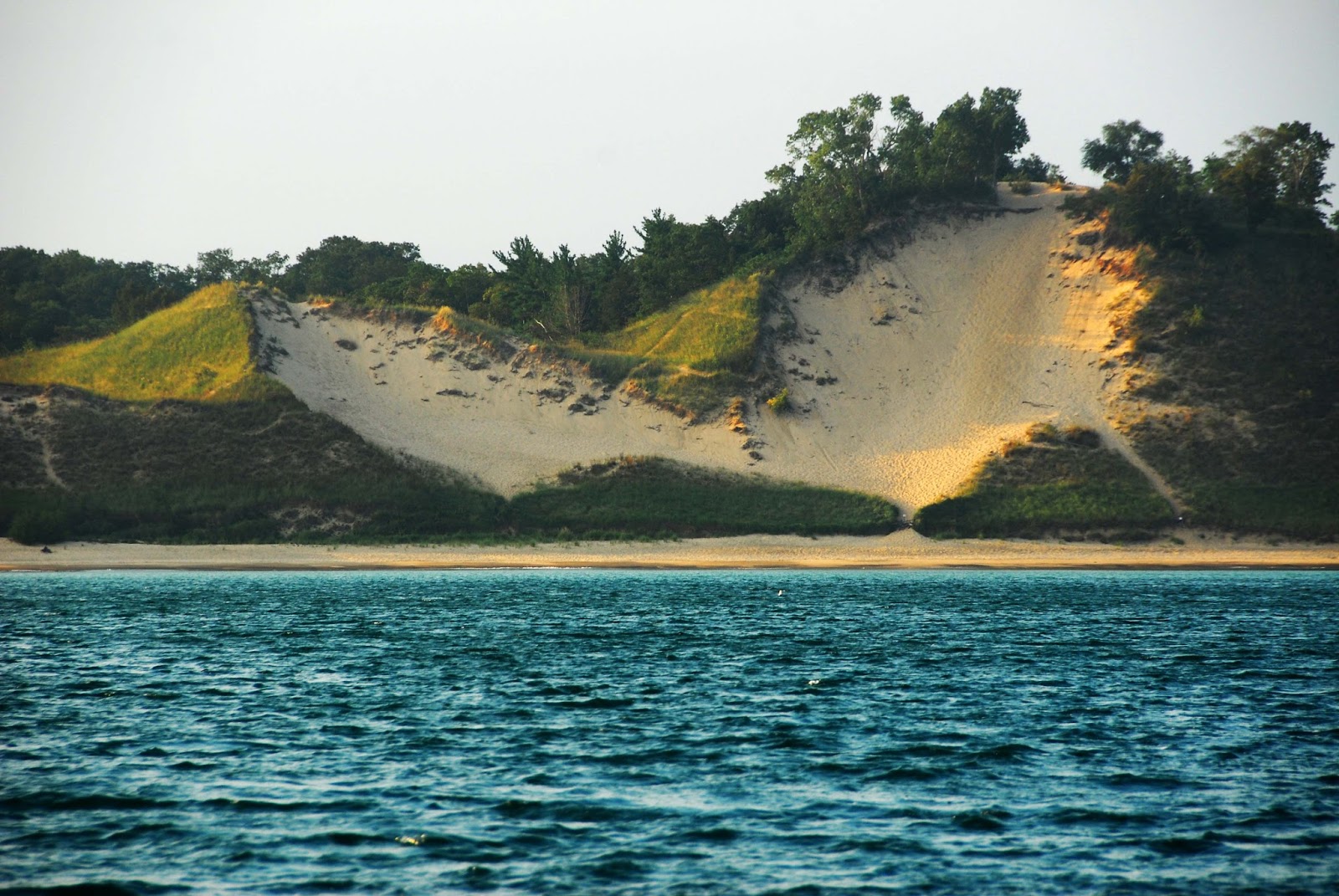
The shoreline of Michigan is just a series of sand dunes, the largest up at the Sleeping Bear Dunes National Lakeshore. They don't stop at the state line, though.


The Indiana Dunes National Lakeshore has large dunes, maybe just not quite as tall as the State of Michigan's.


Early morning light strikes the Indiana dunes.


Up the Calumet River, Down the Mast


We’ve both fought colds in Michigan and are glad to have won the battle about the time we left the lake. We're still dragging a little, though. 


To make the trip easier, we chose to have the mast lowered at Crowley's Yacht Yard on the Calumet River. The river is an alternative route to the inland river system, one that we're taking instead of going up the Chicago Sanitary and Ship Canal through downtown Chicago.


We're trying to make a photo video of the lowering and will post it on the blog if it works.


The highlight of the day was seeing Brad, a city planner and writer, who is Kent's cousin's son. That makes him Kent's cousin once removed or is it second cousin? He was a great help, bringing ice and bubbly to celebrate completing our Loop later, and taking us to the grocery store to provision. For those and many other reasons, we're glad he's part of our family.


Next: To the Illinois River


Friday, September 6, 2013

Michigan -- Like the Florida Keys


. . . Only Colder

"Don't mess with Michigan,"
this mute swan seems to say. We
blinked first in the staredown.


Or so said a T-shirt we saw recently. And actually, that’s not far from the truth. We really, really like Michigan, just like we really, really like the Keys. It’s the eight months of cold weather here that drives us southern riff-raff away.

What we like about Michigan are:

Safe, convenient places for boaters to stop – The State of Michigan runs exceptional harbors of refuge. We think it's the only state with such a system. 

Along the Michigan shoreline of Lake Michigan and Lake Huron, Michigan Harbors of Refuge (MHR) have been set up almost every 20 miles or so to help boaters escape storms on the lake. Some MHRs are just a safe place to anchor. Most MHRs give boaters the option of anchoring or going to a reasonably priced marina. 


The marinas are usually older, but kept in great condition. That said, the docks and boaters’ showers at the Leland Township Marina were brand new.


Fisherman on the Grand Haven entrance pier.
By our count, he has seven rods.

A Fishing Paradise – We had no idea what a fishing paradise Michigan is. It turns out that fishing is the state’s fourth major industry, after auto manufacturing (#1), farming (#2), and timber (#3). 

Fresh or smoked whitefish and trout can be bought just about everywhere. Also, salmon. Yes, salmon! The states surrounding Lake Michigan stock it with three different varieties of salmon. Everyone who owns a boat goes out to catch a salmon or two or nine -- the legal daily limit – and quite a few people in Michigan own boats.  We were surprised at the increasing volume of fishermen, women and families on the water the farther down the coast we went.  


Serious Michigan fishing boats bristle with rods, like porcupines.


Even the little boats have multiple rods. This boat has eight.


Many of the municipal marinas have elaborate fish cleaning stations, with four long aluminum tables, overhead hoses to keep them washed off, and a grinder for bones, skin and other discarded fish parts. 


We thought the Pacific Northwest was the only place that produced salmon. At the marina laundry room, we talked with Ludington boaters, Glen and Yvonne, about our surprise to find salmon here. They kindly gave us a nice slab of fresh salmon that they caught the day before. Delicious!


Fishtown, part of Leland, Michigan, is one of the last Great Lakes towns to still use fish tugs, like the Janice Sue. By 1905, fishermen began to replace sail-powered fishing boats with motor-powered boats with large cabins. The motors and cabins allowed fishermen to fish longer in the year and in a larger area. In 1958, the Janice Sue was launched as the first steel-hulled fish tug to be used in Fishtown. Before that, they were wood.


Fishtown still has a thriving commercial and charter fishing business. Its tourist business is thriving, too.


Clean lakes, clean towns – The Michigan waters in Lake Huron were clear and Caribbean blue-green. The deeper Lake Michigan waters are dark blue, sometimes teal-colored where the bottom is sandy. Both lakes are really clean, as are the lakeshore towns – no trash, little graffiti, lots of murals instead.


What is this, you ask?  It's the beautiful, clear water of Lake Michigan taken while the boat was sailing at seven mph. We could look down 35 feet to the bottom. Although the photo doesn't show what we saw,
we hope you get the sense 
of how gorgeous the water is. 


To quote another T-shirt, Lake Michigan is unsalted and shark-free. Take that, Florida Keys!


Charlevoix, the town of petunias, has the flowers planted everywhere. Its municipal marina is next to downtown restaurants, retail stores, and yet more fudge and ice cream shops.


Great beauty -- So many parts of Michigan are beautiful. We'll only mention one outstanding one -- Sleeping Bear Dunes. A few years ago, viewers of ABC’s Good Morning America voted Sleeping Bear Dunes National Lakeshore as the “Most Beautiful Place in America.”  Although the national lakeshore stretches 35 miles between Leland and Frankfort, the dunes continue all along the coast down to Grand Haven.


The glaciers that carved the Great Lakes deposited glacial sands on plateaus high above the shores. 


The Sleeping Bear Dunes rise up to 400 feet from the lake, varying in color from
light beige to reddish brown. People go there from all over to hike or bike the trails, 
enjoy the miles of lakeshore, sea kayak the lake, learn more about the nature 
and history of the area, or just relax in a beautiful area.


A lot of interesting things to see --


The S.S. Badger prepared to leave Ludington on its first of two trips of the day. The Badger is the last coal-fired passenger ship operating on the Great Lakes, traveling from Ludington, Michigan, to Manitowoc, Wisconsin. Launched 62 years ago to ferry rail cars, 
it now carries cars and passengers exclusively.


A Charlevoix visionary and developer, Earl Young, had an idea to create a neighborhood of unique homes. Most homes looked like imaginary mushroom houses that fairies might live in. This mushroom house was on Round Lake near the marina and, like most of them, has slightly rounded rooflines and a native stone fireplace. Of course, petunias are everywhere.


A flock of mute swans seems to hang out around Frankfort. Beautiful as they are, they aren't native to the U.S. and are considered an invasive species. They look too pretty to be invasive, but maybe someone, sometime said the same thing about Canada geese.


We are not doing Michigan justice with the few things that we've written and shown. There's much more to the state that's worth seeing.


What were they thinking?!

This Frankfort, Michigan, convenience store offered one-stop shopping to make life easier for its customers. At this store, you can buy beer, wine, liquor, live bait and tackle and guns and ammo. It beats the Canadian-government-run liquor store with a dock to make it easy for boaters to buy booze and then go drive their boats around.


Mast Down Again

In towns along Lake Michigan, we've run into lots of other Loopers trying to work through weather windows to get to Chicago soon. We all want to miss the fall winds and waves that build on the lake. The other Loopers are in trawlers or powerboats and can travel farther, faster than we sailboats can. (It is sort-of sad to see them cry at the fuel docks as we put in our 12 gallons of diesel versus the 200+ gallons they buy.)

By early next week, we will reach Chicago and stop a couple of days to have our mast lowered again. With our mast down, we'll leave Lake Michigan to enter the Calumet-Saganashkee Channel, the start of the river system that will take us home. 


The sunrise became a fireball when we left Frankfort with Mike and Cindy on Aurora. 

Thursday, August 29, 2013

Island Hoppin'

. . . In Northern Michigan


It's been a week since we sailed into Michigan. So far, we've island hopped to Drummond where we cleared U.S. Customs, to Mackinac where we were tourists for a day, and to Beaver where we holed up from high winds and waves.


Every year a crew of Chattanooga sailors and friends travel up to Mackinac Island to sail in the Mackinac to Chicago race -- often winning!  That race was all we knew about Mackinac Island until now. 


Mackinac Island


Fort Mackinac is the major historic site on the island. Built in 1780, it was a strategic link in defense of the Strait of Mackinac and Lake Michigan.


Today the island is a summer resort with more bed-and-breakfast inns per square inch than anywhere we’ve visited. The only way to reach Mackinac Island is by private boat or ferry.


On Mackinac, walkers, bikers and horse-drawn wagons abound. Motor-driven vehicles aren’t allowed. Here, a wagon loaded with boxes passes a tour trolley waiting for passengers.


Mackinac Island is also known for its fudge. Chocolate fudge, double dark chocolate fudge, chocolate and peanut butter fudge, chocolate mint fudge, chocolate turtle fudge, maple fudge, maple walnut fudge, vanilla fudge, the varieties go on and on.

Mackinaw City


From Mackinac Island, we traveled to Mackinaw City across the Strait. Okay, Mackinaw City isn’t an island, but its residents obviously have the right island attitude. . . "It's Five O'Clock Somewhere" and "No Shoes. No Shirt. No Problem."


Talk like a Michigander

Our Michigan Looper friends, Mike and Gay, on the trawler Irish Attitude, taught us to talk like native Michiganders. For example, UPers are people who live in the Upper Peninsula and regarded as lacking sense by the rest of Michigan. Of course, UPers regard people who live below the Mackinac Bridge as Trolls. We guess that makes us Temporary Trolls, now that we’ve passed below it. And then there’s The Mitt. Michiganders use the palm side of their right hand as a map of their state to point to their home town.

Gold Flag Loopers

We’d first run into Irish Attitude in New York State, waiting for word on the Erie Canal opening. Mike and Gay left with a couple of other Loopers to start the Champlain Canal a few days ahead of us. We kept running into them in Canada. At Mackinaw City, we were able to celebrate Irish Attitude “crossing its wake” (completing the Loop) and to see them replace their white Looper flag with the gold one they are now entitled to fly.

Crossing your wake is a bittersweet time. Loopers are happy to finish a long (6,000 miles), sometimes hard trip. Yet Loopers get so absorbed in the adventure that it's sad to see it end. 


The sun rose on the UP and the Mackinac Bridge, a 4-mile-long, 
135-foot-high bridge over the Strait of Mackinac. It's called The Big Mac here.

Beaver Island

Our latest weather experience has been in winds of 30+ with gusts of 52 knots (on the anemometer right), with waves of 2 feet – at the dock in St. James Harbor on Beaver Island. 


From Mackinaw City, we had motor sailed to Gray’s Reef. That’s where most Loopers either curve south toward Charlevoix or Petroskey if the winds and waves are favorable, or continue straight to Beaver Island for protection. At Gray’s Reef, trawler friends about five miles ahead who had curved around toward Charlevoix said that the wind and waves had increased. They were occasionally seeing six-foot waves. We decided to tuck into Beaver Island. A weather front moved through, causing the turbulent weather at the dock. It gave us a two-day layover and a chance to get to know this interesting island.

Beaver Island is the largest island in Lake Michigan and can only be reached through St. James Harbor to the north of the island. Originally settled a thousand years ago by Native Americans, it was the French who gave Beaver Island its name in their search for beaver pelts.


The island's history became richer in 1847 when James Strang moved there. He started a Mormon community that grew to 2,700 (today the island's summer population is about 300), had five wives, and appointed himself king. He saw himself as the successor to Joseph Smith in the Mormon Church and saw Beaver Island as the start of his kingdom. Nine years later, he was assassinated by his own people.

After his followers fled or were chased away, Irish immigrants settled on Beaver Island. Irish national flags still fly around St. James Village.


Gaelic sign welcomes visitors to Beaver Island.


Beautiful water, terrible price

Since Mackinac Island, we’ve admired the clear water. We thought it was because Michigan and other Great Lakes states took strong steps to keep it clean. No, it is because of Zebra mussels. They are an invasive species from Russia that we’re trying to keep out of southern rivers and lakes.

Each tiny mussel will filter one gallon of water a day, eating its nutrients. The result is that fish and other aquatic life lack the food to flourish. You can see 30 feet down in crystal clear water, but what you don’t see are fish close to shore.

A Drain on the Great Lakes

The Great Lakes also have to deal with the issue of dropping water levels. Climate change in recent years has brought less snow and that snow melt fills the lakes. Because temperatures are also warmer in the winter, the lakes don't glaze over with ice as they once did. Without that glaze, lake water continues to evaporate all winter. The result is that there are boat houses that are high and dry and stationary docks that require a ladder to get up on from a boat.

Sailing South Again

At Drummond Island, Carina started sailing south again for the first time since December 15! Because of the weather systems that can develop on Lake Michigan, we’re moving south at every chance. 

Although we're on the go, it looks like we won't meet the Looper timetable in Skipper Bob books. He suggests that Loopers be in Chicago by Labor Day.  While we won't make that schedule, we won't be too far behind.